Showing posts with label Sci-Fi. Show all posts

9/02/2010

Ringworld by Larry Niven

Louis Wu has seen it all. Jaded, bored with a world that has no more to offer him, he spends his two hundredth birthday reminiscing about his youth, the good old days when caprice ruled his actions and the world seemed endless in its capacity for excitement. The spark of adventure is still inside him, but Earth, shrunken and standardized by the advent of teleportation, is no longer a place of infinite variety and wonder.

Enter Nessus. A member of the “puppeteers,” an alien race famed for its cowardice, Nessus’s fellows condemn him as insane because of his bravery. Yet they find him useful as an explorer, visiting planets and stars no “sane” puppeteer would dare approach. For his current expedition, he requires companions. Louis immediately signs on to Nessus’s mission, with an excitement fueled by xenophilia and a youthful spirit. Along with two other individuals- Teela Brown, a young human woman, and Speaker-to-Animals, a fearsome alien feline- they set off to investigate the Ringworld, a massive alien artifact shrouded in mystery.

I don’t often use the phrase “thrill ride,” but there’s no other way to describe this book. The numerous plot twists and turns left me guessing every step of the way, and at several points I was left simply marveling at the author’s sheer cleverness. The characters and setting were just as richly detailed and complex as the plot, woven together into a compelling novel with a surprise ending no one could have predicted. Fantastical sci-fi concepts enrich the storyline and are made believable by the smart, polished writing. Creepy insights into what humanity’s future could look like are pure genius (and also really unsettling).

Okay, so this book isn’t exactly new, or YA, but the setting is futuristic and the book has as much action, adventure, and suspense as any novel written for teens. In short, it’s made of awesome. If this book has a downside, it’s that made-up words and new concepts are often introduced with no explanation, and the explanation comes later. A slight flaw, compared to the rest of the book. Five high-tech flashlight lasers- er, daggers.


Futuristically yours,

Tay

11/06/2009

Double Helix by Nancy Werlin


Eli Samuels, high school senior, soon to be high school graduate, is looking for a job. On a drunken impulse, he writes an embarrassing email to Dr. Quincy Wyatt, the most famous geneticist in the world, asking for a job at Wyatt Transgenics, Dr. Wyatt’s company. Eli regrets the email as soon as he sends it. He does not expect that he will actually get the job- after all, he hasn’t even graduated yet, and he’s planning to take a year off before going to college.

Incredibly, Dr. Wyatt gives Eli the job. For a while, it seems too good to be true. Though it’s only an entry-level, lab-assistant job, the work is exciting and the pay is fantastic. Best of all, Eli begins to get to know Dr. Wyatt, a genius scientist, and learns about Dr. Wyatt’s current and future projects. He divides his time between his job, his girlfriend, and spending time with Dr. Wyatt.

But Eli’s dad urges Eli to quit the job, and he won’t say why. He is simply adamant that Eli should not be working for Wyatt Transgenics. Eli knows that his parents used to know Dr. Wyatt, and he suspects that his father’s opposition to his new job has something to do with his mother’s Huntington’s disease, which has left her a ghost of her former self, living in a nursing home. But why exactly, he doesn’t know. And Eli has some secrets of his own- he’s never told anyone, not even his longtime girlfriend, about his mother’s condition, or that he has a fifty-fifty chance of developing the disease himself.

The longer Eli works at Wyatt Transgenics, the more certain he becomes that something is wrong, and the less certain he becomes of everything else.

This book was a fun, quick read. The premise was original and highly intriguing, and there were sufficient unexpected plot twists to keep me interested. Since I am a huge science geek, I was very interested in the work on genetics being done at Wyatt Transgenics, and the idea that someday, direct and deliberate genetic manipulation might be possible. This book made me think about the ethical ramifications of such manipulations, and of the study of genetics in general.

Initially, I was a bit confused about whether this book was a sci-fi or a mystery, but the mystery aspect soon asserted itself. The mystery was okay. It was an extremely interesting concept, and all the essential elements were there, but I was annoyed by the fact that it seemed to progress in two stages. First there was very limited information, and the mystery was more of a hanging uncertainty than an actual mystery. Then suddenly, there was a sharply defined question with lots of evidence, and the outcome was disappointingly predictable. I felt that some of the plot elements could have been spaced out better throughout the book. Also, at times I wanted to scream at the main character for being an idiot and/or a total jerk.

Overall, I give this book three and a half daggers, for thought-provoking elements, an interesting plot, and science.


Genetically yours,
Tay

10/19/2009

The Risen Empire by Scott Westerfeld


Millennia in the future, light-years away, the Risen Empire spans eighty planets. To the people of the empire, the Risen Emperor, inventor of immortality, and his eternally young sister, the Child Empress, are more than rulers- they are gods. They have ruled for sixteen hundred years, and the empire seems as immortal as they are.

But the empire is not alone in the galaxy. The Rix are a civilization of cyborgs, and their domain lies just outside the Risen Empire. The Rix have no leader and no culture. They are a Spartan civilization with only one goal- to propagate an artificially intelligent “compound mind” across the digital network of every populated planet. They worship these minds just as Imperial citizens worship their emperor. Because of this, the Empire and the Rix are constantly on the edge of war. As the novel opens, the Rix have succeeded in capturing the Child Empress, and in planting a compound mind on the planet Legis XV, the location of the Imperial palace.

Captain Laurent Zai is in command of the most powerful starship in the Empire- the Lynx. He has been assigned the task of rescuing the Empress, and the penalty for failure is death by ritual suicide. Light-years away, a senator named Nara Oxham is also becoming entangled with the Rix conflict. Together and apart, destinies closely intertwined, they must both find a way to succeed, or perish in the rising tide of war.

What can I say? It’s by Scott Westerfeld; therefore, it’s amazing. The plot was truly original, which is hard to find in sci-fi these days, and the major cliffhanger at the end left me craving the sequel. Though I don’t think The Risen Empire is actually YA, it reads like one, with cool plot twists and exciting action. The book also makes use of flashbacks and multiple points of view- both common narrative devices, but this time, they’re actually done well. All the events in the book- military, political, dramatic, and romantic- are well executed and convincing.

The real genius of this book, though, was in the details. Scott Westerfeld has managed to convey a vast world with minute precision. Everything, from microspaceships to smartalloy bullets to induced synesthesia to the four types of gravity, is described with a ridiculous amount of detail. While reading this book, I didn’t just feel like I was there. I felt like I knew absolutely everything there was to know about the Rix, the Empire, everything. I was a military officer, a scientific expert, a master pilot, a Rixwoman, and a politician. The world that Scott-la has created is so real, down to the last nanometer.

Strangely enough, this book’s biggest strength is also its biggest downside. Plotwise, it tended to forgo explanation in favor of action, and several times, I found myself rereading the same passage three or four times, trying to figure out what in heaven’s name it was talking about. Most of the cool made-up technical and political jargon is just thrown in there, and explanation comes much later, if at all. I have to admit, the book was more than a little hard to follow. And be warned- it’ll be even harder to follow without a little knowledge of physics, relativity and quantum mechanics.

Still, though, once I figured out what was going on, I enjoyed The Risen Empire enormously. This book has it all- futuristic technology, political intrigue, romance, secrets, lies, cyborgs, undead cats, and obscure, geeky allusions, all woven together in a captivating story. I loved Laurent Zai, Nara Oxham, Rana Harter, H_rd, Alexander, and yes, even the Emperor. I loved it all. I can’t wait for the sequel. Four and a half sixteen-molecule-wide monofilament daggers.

Yours,
Tay


9/24/2009

Noughts and Crosses by Malorie Blackman

Noughts and Crosses, by Malorie Blackman is the tale of a world with a clear class distinction, an alternate universe in which racial and social roles are completely reversed. The world is run by the dark-skinned Crosses and served by the white Noughts—hatefully called daggers and blankers, respectively.

The story is that of Sephy Hadley and Callum McGregor , whose love and friendship struggle against the wide gap between their social standings. Sephy, a Cross, is the daughter of one of the most powerful politicians in the country, while Callum is a low-class “blanker,” and would never have met Persephone had his mother not been working for hers. Still, Sephy and Callum build their friendship in secret hours on a strip of beach and midnight meetings in a rose garden. To them, it doesn’t matter that she is a Cross and he is a Nought; they are both simply people. But when Callum is accepted as one of the first Noughts into Sephy’s all-Cross school, everything changes. And as Callum’s family gets more wrapped up in the violent civil rights terrorist organization known as the Liberation Militia, the stakes get even higher. The story whirls into a fast-paced tale of love and trust and hatred and hurting, race and rights and human nature, all tying into the breathtaking climax; a ending no one could have predicted.

Noughts and Crosses is possibly one of the best books I have ever read.

It could easily have been a simplistic story about how racism is bad and all are equal (which is perfectly good and true, but makes for a rather predictable novel), but Noughts and Crosses delves into the deeper, rawer side of that. Rather than simply black-white racism itself, the story examines human nature and the foundation of prejudice. I think the most important thing was the reversal of who had the power. With the dark-skinned people in charge rather than the light-skinned, real-life politics and pre-formed notions are stripped away, and we are left with simply a picture of prejudice.

What was interesting was how false notions about African Americans that have mostly died out the idea that they smell bad, are less clean, and so on, translated to the blacks’ perception of whites. And it fit perfectly! In this scenario, the whites were portrayed as the dirty second class, and all of the terrible racial stereotypes people held and still hold about blacks are given to the whites in this book. One can see that they have nothing to do with a particular skin color, merely the fact that the color is different and perceived as inferior.

The book studies these ideas far more naturally and subtly than I do, giving them a pronounced presence in the story without ever having to state them bluntly as I have just done. Truly, this book is excellent. It does delve into really interesting questions and ideas, but it also paints a picture of friendship and love startlingly well.

Noughts and Crosses is the first in a trilogy, and I give it five out of five daggers. And no, I don’t mean the fictional slur for the Cross class.

Thinking and mind-blown,

Briar

9/01/2009

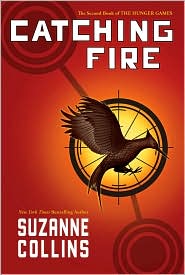
Catching Fire by Suzanne Collins

The Hunger Games, by Suzanne Collins, was the wildly popular dystopia novel released last year. Catching Fire, the eagerly awaited sequel, was equally as riveting—full of extraordinary twists and turns as well as further fleshing of conflicts introduced in its predecessor.

For those unfamiliar with The Hunger Games, the story centers around Katniss Everdeen, who takes her young sister’s place in the The Hunger Games. The Games consist of twenty-four “tributes,” or teenage citizens, who are put in an arena and forced to kill each other off in the hopes of being the last one standing. The book finishes with the end of the Games, and Catching Fire picks up a few weeks after it is all over.

I received this book in early summer as an ARC (Advanced Reader’s Copy) from Scholastic, and positively gobbled it up. The second installment is just as fast-paced and riveting as the first, with even more surprise twists and deeper exploration of the legend of District 13. Katniss grapples with more ethical issues and discovers that whatever she started with the berries in the arena is far from over. A rebellion is stirring, and Katniss finds herself, willing or not, the rallying point of a revolution.

Catching Fire was wonderful. The characters were genuine, and the alternate universe was just as thrilling as it was the first time around. There is the constant, looming threat of the Capitol, and this not-quite-fake charade of love that must be kept up at all times. There is the uncertainty of which boy Katniss should choose, and this whispered revolution that is putting everyone Katniss cares about in danger.

The first half focuses on Katniss’s life in District 12, as well as the victory tour that she and Peeta must go on. There is one massive twist that dictates the second half of the novel so I dare not describe it further, though I will say that the book ends with a huge cliffhanger.

One aspect of this book that did not flow as smoothly as it might have, was that the twists seem a little forced and deliberate—like the novel was so keen on making startling twists that it failed to have the effect of a change that is unexpected.

All in all, however, I think Catching Fire will live up to expectations. There is still the horrifying presence of a “game” in which children are encouraged to kill one another; something I still find difficult to think about. Both books provide originality in a genre that is prone to clichés, and both are well written with genuine characters who suffer real human dilemmas. Five evil daggers, without a doubt.

Yours, Briar

5/02/2009

The Hunger Games by Suzanne Collins

Somewhere in the expansive throes of the future, across a land once known as “North America,” lies a country, Panem. Led by the power-mad and appearance-obsessed Capitol, the country’s twelve districts are forced to offer up two “tributes,” or teenage sacrifices, to partake in the country-wide battle called The Hunger Games. The tributes are chosen by lottery (although one’s name can be entered as many times as one likes, in exchange for a tessera—a year’s worth of grain and oil to help support a poor family). In some countries, participation in the Games is an honor, as one’s district gets showered with money and food for an entire year, and eternal glory is thrust upon the winner. But when Katniss Everdeen, a poor but fiery citizen of District Twelve (the country’s poorest district), finds herself a tribute, her entire world comes crashing down. For you see, the Hunger Games are no ordinary reality show—the twenty-four tributes are placed in an arena in which they must fight to survive not only against the environment, but most of all, their fellow tributes. It is the duty of each tribute to kill as many of each other as they can, for the winner will be the one that is the last to survive as all others are dead.

The Hunger Games, by Suzanne Collins, was a positively riveting book. I felt my eyes were actually glued to the pages, and I finished it in a matter of hours because I found it so difficult to pry myself away. Filled with some astonishing twists and turns, the games themselves were nerve-wracking and heartbreaking, as Katniss would constantly have to remind herself that trusting anyone would result in pain as only one could win, but moreover, a smile and a knife in the back.

The scariest part, perhaps, is that the whole thing reads like a glorified reality show. Sure, it is government run and mandatory to watch—the government likes to remind the citizens just how at-their-mercy they are—but one has to think about how easily we watch reality shows that, by a stretch, were born from the same seed as the Hunger Games.

For Katniss and her fellow tributes, the reality show aspect means that they must be constantly putting on a good face, proving themselves to the audience who have placed bets on their lives, as well as trying to win sponsors who can send them gifts in dire situations.

I was so impressed by this book. It managed to effectively weave a futuristic sci-fi setting with a reality show that is hard to stop turning over in your head, with a commentary on image, as well as a love story. I can’t even weave that sentence to sound ordered or clear, yet Suzanne Collins managed to do so beautifully, creating a book that is a package of sheer suspense and delight.

The first of a trilogy, it has certainly caused a stir among both readers and professionals. Stephenie Meyer and Stephen King both gave rave reviews, and the rights to a movie have been already bought, with the author herself adapting it as a screenplay.

But even more exciting—there is something in which YOU can get involved! The author is hosting a competition in which teens can enter to win an ARC (Advanced Readers Copy) of the book’s sequel, Catching Fire. The entry consists of writing, in 500 words or less, how you would survive the Hunger Games. For more information, check out their website here.But hurry, because the contest ends May 15th!

Again, I absolutely loved this book, and am under the impression that everybody should read it. Unsurprisingly, I give it a whopping and wonderfully evil (oxymoron? no way-- Evil IS wonderful!) five daggers.


Relieved that OUR kind of evil is delightful rather than murderous,
Briar

3/06/2009

Unwind by Neal Shusterman

It's not every day you read a book that officially makes it to the top of the list of "best books I've ever read." But for me, Unwind by Neal Shusterman did just that.

The sci fi-slash-horror story-slash-adventure-slash-romance tale takes place a few generations in the future, after a second civil war in which Pro-Life and Pro-Choice armies battled over the abortion issue. The war ended in a stalemate, and a new compromise was made: All babies had to be delivered and raised to age 13. However, between the ages of 13 and 17, parents could choose to "abort" their children by having them "unwound"--a process in which all of the organs are harvested and donated to hospital patients. In other words, 100% of the "unwind" stays technically alive, just in a divided state.

And although the process sounds shocking and unbelievable, in the story, it has become a common and accepted part of American society. Unwind follows three runaway "unwinds": Conner (who's being unwound because his parents think he's a troublemaker), Risa (a ward-of-the-state who's being unwound to cut costs), and Lev (who was promised to be an unwind at birth as a part of his family's religion, and who has been brainwashed to believe that unwinding is okay because it helps people). And when the government is desperate for organ donors, they will stop at nothing to find runaway unwinds and make sure they don't escape their fate. Lucky for Conner, Lev, and Risa, a secret society of runaway unwinds is just around the corner...if they can only survive to make it there.

Although Unwind is thoroughly packed with action from start to finish, that's not the only reason I loved it so much. In a YA room full of Cliques and Gossip Girls. Unwind really makes the reader think about deep, life-or-death issues. Like, who has the right to say when someone's life is going to end? Is it really okay to commit an act like murder in the name of religion? How far can you go in order to "protect the greater good?" And which is better: aborting thousands of babies that someone could have loved, or having an orphanage full of thousands of babies that no one loves? Unwind explores all of these and many more. Throughout the main story, Neal Shusterman intertwines many different subplots that get you thinking about the values in America and the value of your own life. There's even some laughworthy satire thrown in here and there. I'm warning you now, it's extremely intense, and many of the ideas suggested in the book may upset you. But if you're looking for some meaningful, thought-provoking reading that really changes the way you look at life, death, and your place in the world, then I strongly consider Unwind.

I definitely give this book the full 5 out of 5 daggers.


Misty

12/17/2008

Turnabout By Margaret Peterson Haddix

From Margaret Peterson Haddix comes another strange but intriguing sci-fi mystery, TURNABOUT. Melly and Anny-Beth were two centenarians near death when they were asked to participate in ‘Turnabout,’ a complex scientific experiment designed to reverse the aging process. Eighty-something years later, Melly and Anny-Beth are teenagers again, and they continue to get younger and younger each day. They know almost nothing about the mysterious Turnabout project, what is happening to them, or what will happen when their age hits zero. But they realize they will soon be too young to care for themselves, so they need some answers—fast. Fearful of the many doctors who are trying to study or “cure” them, and with no one to truly trust with their secret, Melly and Anny-Beth embark on a quest to finally get some answers. But at the same time, they find themselves on the run from a mysterious someone who is trying to find out more than Melly and Anny-Beth want to tell.

Turnabout is one of those truly suspenseful books that you just can’t put down. Not only is it a first-rate mystery and a futuristic sci-fi tale; it also raises some deep ethical questions about the scientific/medical world. Melly and Anny-Beth are likable, well-developed characters, and the story is told in an engaging style that makes you just want to keep reading! I was left with some questions at the end, and a feeling that the ending wasn’t fully finished (I won’t go into detail as to avoid spoilers!) But overall, Turnabout is entertaining, suspenseful, mysterious, and thought provoking--all the ingredients of a good mystery.

I award this book 4.5 out of 5 daggers.
Mysteriously Yours,

Misty