Showing posts with label World War II. Show all posts

8/24/2010

The Samurai's Garden by Gail Tsukiyama

In the fall of 1937, a young Chinese man named Stephen is stricken with tuberculosis. Despite the deteriorating political situation in eastern Asia due to Japan’s budding imperialism, Stephen is sent to a small Japanese village called Tarumi, where his family owns a summer house, to rest and recover from his illness. He is to be cared for by the family’s housekeeper, Matsu, a quiet and reserved man whom Stephen knows only as an acquaintance.

As the novel opens, Stephen has no reason to believe that his stay in Tarumi will be anything but relaxing, and he is looking forward to reading and painting, his two favorite hobbies. Soon after he arrives, though, it becomes clear to Stephen that there is more to Matsu than meets the eye. He becomes acquainted with two of Matsu’s old friends, named Kenzo and Sachi, and slowly begins to discover the secrets of their difficult past. As time passes, as he becomes immersed in Japanese life and culture, forges friendships with the enigmatic Sachi and Matsu, and participates in a romance, Stephen begins to feel more and more at home in Tarumi, a place that is at once turbulent and peaceful.

This book takes place against the backdrop of 1930’s Japan. At the time, Japan was fully industrialized and seeking dominance over its less modernized neighbors, especially China; this aggressive foreign policy was one of the contributing factors to Japan’s later involvement in World War II. The novel makes frequent reference to radio news reports- from both perspectives- of Japan’s victories over the Chinese army; it is interesting to see the contrast between the Chinese and Japanese reports of the same battles, underscoring the effect of bias in the media.

The people, food, dress, and customs of the vibrant Japanese culture were portrayed colorfully throughout the book, while the author’s sparse, clear prose beautifully evoked the clean, elegant style of Asian art and poetry. The plot was well-developed and reasonably interesting, incorporating an intricate storyline within a compact package. I was especially impressed by the complex characterization, which was well-executed and made the characters seem vivid and real.

Ironically, however, despite the fact that the novel is written in first person, the protagonist Stephen is remarkably underdeveloped compared to the other characters; his lack of any distinguishable traits is in sharp contrast to the richly layered personalities of the other main characters. The awkward, boring, and halfhearted romantic element of the story is unnecessary- I feel that the novel would be better off if the romantic subplot were replaced with actual development of Stephen as a character.

Despite its shortcomings, though, this book was a success. It was, a bit surprisingly, thought-provoking; the hardships described by the characters made me reflect on what I would have done in the same situations, and the descriptions of a beautiful culture immersed me. The writing style was unpretentious and refreshingly clean. Overall, it was a complex and detailed novel bound up into a deceptively small package. I award it four daggers.


Yours,
Tay

5/22/2010

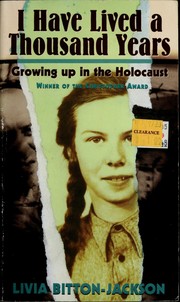
I Have Lived a Thousand Years by Elli Friedmann

Elli was thirteen years old; clever, ambitious, funny, and terribly excited about her new bike. She had friends and a crush and a wonderful family—a pretty good life. Until the Nazis invaded her town. In one fell swoop, her life came out from under her. Her school was closed permanently, and all of her hard work and top-notch grades were forgotten, disregarded. Her shiny new bike was confiscated, and her bright teenage clothes were spoiled by ugly yellow stars that were fastened, one by one, to her lapels. All because she was a Jew. Yet in a few months time she would be wishing desperately for the days when she was simply discriminated against, when at least her family was united and her dignity remained.


I Have Lived a Thousand Years is haunting, stirring, terrifying, and most frighteningly of all, real. The book is survivor Livia Bitton-Jackson's autobiographical account of the Holocaust. Only thirteen when her family was carted off to different concentration camps, Elli endured a year of different camps and horrors, staying alive only by a series of lucky chances. She was first confined to a ghetto with her family, then sent to Auschwitz, Plaszow, Auschwitz again, Ausburg, Waldlager and was ultimately liberated in 1945. Elli saw and survived the very worst horrors of the Holocaust.


And she holds nothing back. With terrifying detail she tells us of the whispers about the smoke that rose over Auschwitz, the sickening and unbelievable reality that was the human bodies that made it. She tells us of her nerves the night before decimation, a process in which the entire camp is lined up and set to face a firing squad. Every tenth person is shot, yet one never knows where the count will begin or who will be the doomed tenth. She describes legs and limbs shot off live bodies, skeletal prisoners working torturous twelve hour days, and the constant, deep, gnawing presence of hunger. She describes the sun blisters that cracked and oozed upon her shaven head, the biting burns that pierced her skin, and the sharp lash of the whip as it made contact with her young flesh.


The book is sickening yet riveting. Like an accident you can’t look away from, I Have Lived a Thousand Years is impossible to read yet impossible to put down. It is an incredible, horrible, fascinating book. The author speaks about the surprising extent of human cruelty, the horrors of the pain and the torture and the death that were brought about by people, good people, people who got caught up in unity and superiority and were diminished to mindless, brainwashed, murderous monsters. And her faith in humanity was extinguished at just thirteen. At thirteen, should have been attending dances and doing homework and coming home each day to her mother and father. Instead, she was forced to live in a concentration camp, holding her breath with anxiety each day as she waited to be sent to the gas chambers.


I have read a lot of Holocaust books for young adults, and many of them were excellent. But nothing even approaches the rawness and the truth and the prose that this book is. 5 daggers.


Yours,
Briar

8/12/2009

The Book Thief by Markus Zusak

A while back, the wonderful Tay posted a review on The Book Thief by Markus Zusak. I read the book, and thought it was so wonderful and special that I simply had to review it myself. Tay's awesome review can be found below mine, so you can compare our experiences with the book.

The Book Thief, by Markus Zusak, is the inspiring story of a young German girl who is growing up in the midst of World War II. Abandoned by her mother, underfed and constantly reprimanded by her loving but fierce foster-mother, Leisel Meminger is a girl who finds all the brightness of life in words. Words are her greatest love and her most infuriating enemy—words are the things that allow her to live but Hitler to control and rule.

Hitler, Leisel realizes, can change a country’s image of Jews by using words to warp them into something disgusting, malicious, and sub-human. He can take a country that is scared and off-balance, and use words to soothe and hypnotize. Hitler uses words as his single greatest weapon, and without them, he would be powerless.

On the other hand, Leisel uses words to explore and grow. She uses words and books as her sanctuary in the fear-filled world of Nazi Germany. She uses words to light the eyes of the frail Jewish man in her basement, reminding him of sunlight and happiness as she describes clouds that resemble ropes and a brilliant dripping sun. Leisel uses words to spark happiness and gain knowledge—without them, she would be powerless, too.

This tale of words and power is told in the point of view of an unlikely narrator—Death himself. Death is not God, nor does he even decide when one will die; his job is simply to carry away the souls of the deceased. The best souls, we learn, sit up to meet him, reluctant to die but accepting all the same. Death is in the perfect position make to such striking observations about death and war—he likens himself to the best Nazi, killing and killing and yet still being asked for more.

For the first half of the novel, I was fairly interested in the subject of the story and intrigued by the unorthodox choice of narrator, but was not bringing the book with me everywhere as I later would. It was no chore to read, but it was no great treat either. However, once half of the book was finished and I was now fully acquainted with the cast of characters and the author’s writing style, the story began to pick up. I found myself increasingly interested in the events that took place and by the end of the novel I was practically ripping at the pages, shaken and moved by the beautiful description and the heartfelt dialogue. The author introduced the story’s ending about three quarters in, but the warning did not dilute the power of the end, it made it more poignant. Somehow both times the ending was explained (the first merely an outline, the second fully fleshed out) it was shattering and breathtaking.

The Book Thief takes a while to get started, but once you’re hooked, you simply can’t stop reading. It’s a powerful story of loss and happiness, love and heartbreak, reading and rule and life. Four and a half evil daggers.

Yours,

Briar


Set in Germany in the early 1940’s, The Book Thief is the heartwarming and heartbreaking story of a foster child, fourteen books, many colors, an accordion, death, a Jewish fist fighter, a basement, two wars, a kiss, and a boy with hair the color of lemons.

Liesel Meminger has witnessed more than her share of horrors. Her father disappeared when she was little, and an aura of mystery still surrounds his name. Her brother died on a train on the way to their foster home in Molching, Germany. And there are more horrors to come, though Liesel has no way of knowing. Through it all, Liesel turns to books as a refuge from the death, abandonment, and fear that fills her life, and the lives of all those around her.

Liesel’s long and illustrious career in book thievery begins with The Grave Digger’s Handbook, stolen from the snow at her brother’s burial. Next comes The Shoulder Shrug, stolen from fire. Liesel continues to steal books wherever she can find them. But her personal peace cannot last, and soon the danger of the war looms closer, lurking even within her own home, drawing her always closer to the inevitable. Liesel’s life becomes one of secrets and lies, and truth comes from the most surprising places.

This book is simply amazing. The author has a way of making the smallest details- the color of someone’s eyes, or the texture of their hair- the most important, and mystery is interwoven with every event, no matter how tiny. The unusual format, cavalier use of foreshadowing, and, shall we say, unconventional narration make the book a bit confusing in places, but really drive the point home. On the whole, this is a fabulous, yet absolutely heartbreaking book, and an unusual perspective on World War II. I give it the full five daggers, reluctant that there are no more to give.


Yours,
Tay