Showing posts with label holocaust. Show all posts

5/22/2010

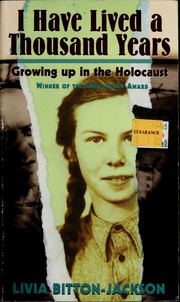
I Have Lived a Thousand Years by Elli Friedmann

Elli was thirteen years old; clever, ambitious, funny, and terribly excited about her new bike. She had friends and a crush and a wonderful family—a pretty good life. Until the Nazis invaded her town. In one fell swoop, her life came out from under her. Her school was closed permanently, and all of her hard work and top-notch grades were forgotten, disregarded. Her shiny new bike was confiscated, and her bright teenage clothes were spoiled by ugly yellow stars that were fastened, one by one, to her lapels. All because she was a Jew. Yet in a few months time she would be wishing desperately for the days when she was simply discriminated against, when at least her family was united and her dignity remained.


I Have Lived a Thousand Years is haunting, stirring, terrifying, and most frighteningly of all, real. The book is survivor Livia Bitton-Jackson's autobiographical account of the Holocaust. Only thirteen when her family was carted off to different concentration camps, Elli endured a year of different camps and horrors, staying alive only by a series of lucky chances. She was first confined to a ghetto with her family, then sent to Auschwitz, Plaszow, Auschwitz again, Ausburg, Waldlager and was ultimately liberated in 1945. Elli saw and survived the very worst horrors of the Holocaust.


And she holds nothing back. With terrifying detail she tells us of the whispers about the smoke that rose over Auschwitz, the sickening and unbelievable reality that was the human bodies that made it. She tells us of her nerves the night before decimation, a process in which the entire camp is lined up and set to face a firing squad. Every tenth person is shot, yet one never knows where the count will begin or who will be the doomed tenth. She describes legs and limbs shot off live bodies, skeletal prisoners working torturous twelve hour days, and the constant, deep, gnawing presence of hunger. She describes the sun blisters that cracked and oozed upon her shaven head, the biting burns that pierced her skin, and the sharp lash of the whip as it made contact with her young flesh.


The book is sickening yet riveting. Like an accident you can’t look away from, I Have Lived a Thousand Years is impossible to read yet impossible to put down. It is an incredible, horrible, fascinating book. The author speaks about the surprising extent of human cruelty, the horrors of the pain and the torture and the death that were brought about by people, good people, people who got caught up in unity and superiority and were diminished to mindless, brainwashed, murderous monsters. And her faith in humanity was extinguished at just thirteen. At thirteen, should have been attending dances and doing homework and coming home each day to her mother and father. Instead, she was forced to live in a concentration camp, holding her breath with anxiety each day as she waited to be sent to the gas chambers.


I have read a lot of Holocaust books for young adults, and many of them were excellent. But nothing even approaches the rawness and the truth and the prose that this book is. 5 daggers.


Yours,
Briar

3/10/2010

The Wave by Todd Strasser

The Wave, by Todd Strasser, is the story of Gordon High School, a regular American institution of lockers and bells, dreaded phys ed and social cliques. The novel takes place in the early 1970s, separated by years and oceans from the genocide of World War II. As they learn about the Holocaust in history class, everyone acknowledges that indeed, the Holocaust was horrible and despicable, but they all are equally certain that something like that could never happen in present day. Concerned with this complacency, the history teacher, Mr. Ross, sets out to show his students that a situation like Nazi Germany is never out of reach.

His experiment begins harmlessly enough; students must stand at attention before answering a question in class and say “Mr. Ross,” crisply before speaking. But gradually the experiment grows, there is a salute and a sign and the new way of acting carries beyond the classroom. Soon this experiment, called The Wave, has spread through the school, a special society in which all are strong, disciplined, equal.

Yet with the power and the unity of the Wave comes negative aspects, as well. Gradually, as more and more students join the Wave, they begin to get intoxicated with the mass feeling of brotherhood and security among their fellow Wave members. To help foster this bond, Mr. Ross organizes rallies and meetings only for Wave members, and in a surprisingly short amount of time the majority of the school is fully on board with the Wave and all that it stands for. Although once a member, all are supposedly equal and accepted, those few students who resist the Waves begin to experience negative repercussions. They are separated from their friends as they are not allowed at Wave rallies or lunches, and Wave members quickly take it upon themselves to ban non-Wave members from school events like sports games. They are ridiculed, isolated, even beaten. All those who are not part of the Wave are enemies to it, and a school that was once simply a school has become the headquarters of this hungry new regime.

The Wave is a terrifying picture of the tangibility of Nazi Germany. We find that the Nazis were not simply a huge concentration of bigoted, wicked people, but, dare I say it, people like us who went horribly wrong? In the Wave, we see how it is to get swept up in the tantalizing and reassuring world of mindlessness. Members of both the Nazi party and the Wave were freed of their obligation to make choices. They did not have to be different. And because they were human, fallible, swayable, they fell into the Nazi mold and became monsters, committing unspeakable acts of evil.

And that is why the Wave is so frightening. It shows us how susceptible even we are to falling into something like Nazi-hood or the Wave. Hitler with the Third Reich and Mr. Ross, the history teacher with the Wave, both designed their regimes to play into human vulnerabilities, to exploit them and use them to turn people blind and unfailingly obedient.

The Wave is short, no more than a compact 125 pages, but within those pages is a startling and incredible read. I’ve read the novella several times, and each time the blow is just as strong, just as incredible, and just as terrifying. It is well written and well researched, based off a 1980 classroom experiment much like the one depicted in the book. It is scary to read but absolutely riveting, and essential for us to read if we are to understand the lure of mindless unity and protect ourselves against it. The Wave is, without a doubt, one of the best books I have ever read.

Five out of five daggers, absolutely.

8/12/2009

The Book Thief by Markus Zusak

A while back, the wonderful Tay posted a review on The Book Thief by Markus Zusak. I read the book, and thought it was so wonderful and special that I simply had to review it myself. Tay's awesome review can be found below mine, so you can compare our experiences with the book.

The Book Thief, by Markus Zusak, is the inspiring story of a young German girl who is growing up in the midst of World War II. Abandoned by her mother, underfed and constantly reprimanded by her loving but fierce foster-mother, Leisel Meminger is a girl who finds all the brightness of life in words. Words are her greatest love and her most infuriating enemy—words are the things that allow her to live but Hitler to control and rule.

Hitler, Leisel realizes, can change a country’s image of Jews by using words to warp them into something disgusting, malicious, and sub-human. He can take a country that is scared and off-balance, and use words to soothe and hypnotize. Hitler uses words as his single greatest weapon, and without them, he would be powerless.

On the other hand, Leisel uses words to explore and grow. She uses words and books as her sanctuary in the fear-filled world of Nazi Germany. She uses words to light the eyes of the frail Jewish man in her basement, reminding him of sunlight and happiness as she describes clouds that resemble ropes and a brilliant dripping sun. Leisel uses words to spark happiness and gain knowledge—without them, she would be powerless, too.

This tale of words and power is told in the point of view of an unlikely narrator—Death himself. Death is not God, nor does he even decide when one will die; his job is simply to carry away the souls of the deceased. The best souls, we learn, sit up to meet him, reluctant to die but accepting all the same. Death is in the perfect position make to such striking observations about death and war—he likens himself to the best Nazi, killing and killing and yet still being asked for more.

For the first half of the novel, I was fairly interested in the subject of the story and intrigued by the unorthodox choice of narrator, but was not bringing the book with me everywhere as I later would. It was no chore to read, but it was no great treat either. However, once half of the book was finished and I was now fully acquainted with the cast of characters and the author’s writing style, the story began to pick up. I found myself increasingly interested in the events that took place and by the end of the novel I was practically ripping at the pages, shaken and moved by the beautiful description and the heartfelt dialogue. The author introduced the story’s ending about three quarters in, but the warning did not dilute the power of the end, it made it more poignant. Somehow both times the ending was explained (the first merely an outline, the second fully fleshed out) it was shattering and breathtaking.

The Book Thief takes a while to get started, but once you’re hooked, you simply can’t stop reading. It’s a powerful story of loss and happiness, love and heartbreak, reading and rule and life. Four and a half evil daggers.

Yours,

Briar


Set in Germany in the early 1940’s, The Book Thief is the heartwarming and heartbreaking story of a foster child, fourteen books, many colors, an accordion, death, a Jewish fist fighter, a basement, two wars, a kiss, and a boy with hair the color of lemons.

Liesel Meminger has witnessed more than her share of horrors. Her father disappeared when she was little, and an aura of mystery still surrounds his name. Her brother died on a train on the way to their foster home in Molching, Germany. And there are more horrors to come, though Liesel has no way of knowing. Through it all, Liesel turns to books as a refuge from the death, abandonment, and fear that fills her life, and the lives of all those around her.

Liesel’s long and illustrious career in book thievery begins with The Grave Digger’s Handbook, stolen from the snow at her brother’s burial. Next comes The Shoulder Shrug, stolen from fire. Liesel continues to steal books wherever she can find them. But her personal peace cannot last, and soon the danger of the war looms closer, lurking even within her own home, drawing her always closer to the inevitable. Liesel’s life becomes one of secrets and lies, and truth comes from the most surprising places.

This book is simply amazing. The author has a way of making the smallest details- the color of someone’s eyes, or the texture of their hair- the most important, and mystery is interwoven with every event, no matter how tiny. The unusual format, cavalier use of foreshadowing, and, shall we say, unconventional narration make the book a bit confusing in places, but really drive the point home. On the whole, this is a fabulous, yet absolutely heartbreaking book, and an unusual perspective on World War II. I give it the full five daggers, reluctant that there are no more to give.


Yours,
Tay


8/01/2008

The Silenced by James Devita

YA ALERT! Check out Briar Kasvi's TOAD HILL review of The Silenced by James Devita. Interesting Fact: James Devita is also a playwrite and actor.