
5/22/2010

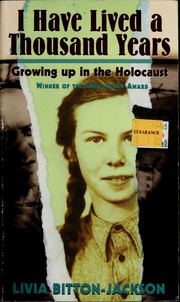
I Have Lived a Thousand Years by Elli Friedmann

Elli was thirteen years old; clever, ambitious, funny, and terribly excited about her new bike. She had friends and a crush and a wonderful family—a pretty good life. Until the Nazis invaded her town. In one fell swoop, her life came out from under her. Her school was closed permanently, and all of her hard work and top-notch grades were forgotten, disregarded. Her shiny new bike was confiscated, and her bright teenage clothes were spoiled by ugly yellow stars that were fastened, one by one, to her lapels. All because she was a Jew. Yet in a few months time she would be wishing desperately for the days when she was simply discriminated against, when at least her family was united and her dignity remained.


I Have Lived a Thousand Years is haunting, stirring, terrifying, and most frighteningly of all, real. The book is survivor Livia Bitton-Jackson's autobiographical account of the Holocaust. Only thirteen when her family was carted off to different concentration camps, Elli endured a year of different camps and horrors, staying alive only by a series of lucky chances. She was first confined to a ghetto with her family, then sent to Auschwitz, Plaszow, Auschwitz again, Ausburg, Waldlager and was ultimately liberated in 1945. Elli saw and survived the very worst horrors of the Holocaust.


And she holds nothing back. With terrifying detail she tells us of the whispers about the smoke that rose over Auschwitz, the sickening and unbelievable reality that was the human bodies that made it. She tells us of her nerves the night before decimation, a process in which the entire camp is lined up and set to face a firing squad. Every tenth person is shot, yet one never knows where the count will begin or who will be the doomed tenth. She describes legs and limbs shot off live bodies, skeletal prisoners working torturous twelve hour days, and the constant, deep, gnawing presence of hunger. She describes the sun blisters that cracked and oozed upon her shaven head, the biting burns that pierced her skin, and the sharp lash of the whip as it made contact with her young flesh.


The book is sickening yet riveting. Like an accident you can’t look away from, I Have Lived a Thousand Years is impossible to read yet impossible to put down. It is an incredible, horrible, fascinating book. The author speaks about the surprising extent of human cruelty, the horrors of the pain and the torture and the death that were brought about by people, good people, people who got caught up in unity and superiority and were diminished to mindless, brainwashed, murderous monsters. And her faith in humanity was extinguished at just thirteen. At thirteen, should have been attending dances and doing homework and coming home each day to her mother and father. Instead, she was forced to live in a concentration camp, holding her breath with anxiety each day as she waited to be sent to the gas chambers.


I have read a lot of Holocaust books for young adults, and many of them were excellent. But nothing even approaches the rawness and the truth and the prose that this book is. 5 daggers.


Yours,
Briar

5/02/2010

English Passengers by Matthew Kneale

Set in the mid-19th century, when British imperialism was at its pinnacle and explorers were mapping the last uncharted corners of the globe, English Passengers spins a delicious yarn of intrigue, torment, and reckless lawbreaking on the high seas and within the plains and forests of Tasmania. It is crewed by a fascinatingly diverse cast of characters, including a likable yet eccentric rum-smuggling captain by the name of Illiam Quillian Kewley, a motley band of seafaring Manxmen, an unlikely trio of obnoxious Brits, and a tormented tribe of indigenous Tasmanians.

Captain Kewley and the crew of his smuggling ship Sincerity are expecting a brief, profitable maiden voyage. But after enduring one misfortune after another, due to “prying British Customs men,” they are forced to take on passengers for charter to Tasmania. Reverend Wilson, Dr. Potter, and Timothy Renshaw promptly proceed to make life extremely difficult for each other and for the ship’s crew, resulting in a brilliantly written comedy of errors populated by the most outrageous fools ever to set foot on a ship.

But awaiting the travelers in Tasmania is something utterly unexpected. Interspersed with the humorous antics of the travelers is the heartwrenching narrative of Peevay, the son of a Tasmanian native and a British sailor, who describes with fierce emotion the torments his people have endured from British colonizers. The book’s two main subplots gradually become intertwined, finally merging near the end and drawing the reader into the novel’s uniquely satisfying conclusion.

Though I normally don’t like historical fiction as much as other types of literature, I enjoyed and deeply appreciated this book. It made me laugh out loud with its sidesplittingly hilarious wit, it brought tears to my eyes with its raw descriptions of horrors inflicted by men, all while managing to deliver a time-honored message of tolerance and peace without being tired or clichéd. The writing successfully captures the unique personality and regional dialect of each character while still reflecting the author’s eloquent voice and creating a thoughtful, polished piece.

The remarkable thing about English Passengers is how it manages to be so many things at once. This novel is a window into a time long past, a thrillingly adventurous romp, a first-rate comedy and a tale of real-world strife, all rolled into one. I award it five daggers without hesitation.


Yours,
Tay

3/12/2010

Another Faust by Daniel and Dina Nayeri

One night, five children mysteriously disappear from their homes in Paris, Glasgow, Rome, and London. Five years later, the five teenagers and their governess, Madame Vileroy, arrive at an exclusive holiday party in New York. The Faust "family" has just enrolled in Marlowe, a school for elite students, in the middle of the year. They use their "gifts" given to them by Madame Vileroy to rise to suspicious heights at Marlowe. Driven by selfish obsession and making deals with the very devil, the Faust teens draw nearer their goals. That is, until two of them uncover a secret.

Another Faust is an exciting book. The plot draws you in more and more as you read on. During the last few chapters, the book becomes very difficult to put down. I commend the writers on such a well paced build up. Another exceptional aspect of the book's writing is the short "pre-chapters." At the beginning of every chapter, there are a few sentences/paragraphs of italicized writing. They usually do not relate to the story at the present, but over time, their meaning becomes clear. Either that, or they foreshadow a future plot development. The pre-chapters add suspense but also aid understanding. It is a creative, enriching touch.

As mentioned in the plot summary above, the children make deals with the very devil. The devil exploits their weaknesses and desires to coerce them into making deals. This a very interesting concept, although not original to this book (it is not called Another Faust for nothing). There a personal conflict between immediate gratification and redemption. It makes a meaningful story, but sometimes, this one character comes off as downright repulsive. The girl, Victoria, is obsessed with winning. She makes a deal so she can read minds to cheat. She is absolutely soulless. Everything about her revolves around being the best and winning. She can be really obnoxious, but the book would suffer without her presence. If you ever become disgusted with her while you are reading, just keep going. It will get better. Fortunately, not all the characters are as horrible as Victoria.

The fierce faults of Victoria might not upset you. I just felt a little threatened. I mean, honestly, this girl got to make a deal with the devil! And I call myself an evil cousin... I shall have to try harder.

I give Another Faust by Daniel and Dina Nayeri a Satanic 4 out of 5 daggers.


Devilishly yours,
Gabriel Gethin

3/10/2010

The Wave by Todd Strasser

The Wave, by Todd Strasser, is the story of Gordon High School, a regular American institution of lockers and bells, dreaded phys ed and social cliques. The novel takes place in the early 1970s, separated by years and oceans from the genocide of World War II. As they learn about the Holocaust in history class, everyone acknowledges that indeed, the Holocaust was horrible and despicable, but they all are equally certain that something like that could never happen in present day. Concerned with this complacency, the history teacher, Mr. Ross, sets out to show his students that a situation like Nazi Germany is never out of reach.

His experiment begins harmlessly enough; students must stand at attention before answering a question in class and say “Mr. Ross,” crisply before speaking. But gradually the experiment grows, there is a salute and a sign and the new way of acting carries beyond the classroom. Soon this experiment, called The Wave, has spread through the school, a special society in which all are strong, disciplined, equal.

Yet with the power and the unity of the Wave comes negative aspects, as well. Gradually, as more and more students join the Wave, they begin to get intoxicated with the mass feeling of brotherhood and security among their fellow Wave members. To help foster this bond, Mr. Ross organizes rallies and meetings only for Wave members, and in a surprisingly short amount of time the majority of the school is fully on board with the Wave and all that it stands for. Although once a member, all are supposedly equal and accepted, those few students who resist the Waves begin to experience negative repercussions. They are separated from their friends as they are not allowed at Wave rallies or lunches, and Wave members quickly take it upon themselves to ban non-Wave members from school events like sports games. They are ridiculed, isolated, even beaten. All those who are not part of the Wave are enemies to it, and a school that was once simply a school has become the headquarters of this hungry new regime.

The Wave is a terrifying picture of the tangibility of Nazi Germany. We find that the Nazis were not simply a huge concentration of bigoted, wicked people, but, dare I say it, people like us who went horribly wrong? In the Wave, we see how it is to get swept up in the tantalizing and reassuring world of mindlessness. Members of both the Nazi party and the Wave were freed of their obligation to make choices. They did not have to be different. And because they were human, fallible, swayable, they fell into the Nazi mold and became monsters, committing unspeakable acts of evil.

And that is why the Wave is so frightening. It shows us how susceptible even we are to falling into something like Nazi-hood or the Wave. Hitler with the Third Reich and Mr. Ross, the history teacher with the Wave, both designed their regimes to play into human vulnerabilities, to exploit them and use them to turn people blind and unfailingly obedient.

The Wave is short, no more than a compact 125 pages, but within those pages is a startling and incredible read. I’ve read the novella several times, and each time the blow is just as strong, just as incredible, and just as terrifying. It is well written and well researched, based off a 1980 classroom experiment much like the one depicted in the book. It is scary to read but absolutely riveting, and essential for us to read if we are to understand the lure of mindless unity and protect ourselves against it. The Wave is, without a doubt, one of the best books I have ever read.

Five out of five daggers, absolutely.

1/25/2010

Prep by Curtis Sittenfeld

Lee Fiora is a modest girl from the Midwest, blessed by luck and hours of effort, who has won a place and a scholarship to the Ault school, a prestigious Northeastern boarding school. Vineyard Vines, Ralph Lauren and J. Crew labels are everywhere to be seen, while the school demands more academically than Lee has ever experienced. Awed and apprehensive, Lee begins her Ault career, unsure of her place in this affluent, preppy world. As the weeks and months continue, Lee becomes progressively more alienated, feeling friendless and very much an outsider. She is not privy to East Coast slang, the favorite brands; her hair is not long and sleek, her body not completely soft and slender. The novel follows Lee for her four years at Ault, during which time she becomes hardly more integrated. She spends the overwhelming majority of her high school years feeling self-conscious and rather miserable, because she feels that any thought, expression or action outside of the norm will alienate her further and cause others to think badly of her.

I liken this feeling of being scrutinized to the concept of the “panopticon,” in the book The Disreputable History of Frankie Landau Banks. A panopticon is a circular jail, arranged around a central well so that the prisoners could be watched at all times. Because of the constant assumption that they were being watched, the prisoners behaved and little watching ever really had to occur. In Prep, and in The Disreputable History of Frankie Landau Banks, the boarding school atmosphere makes for a sort of panopticon—an environment in which everyone feels as though they are always being watched, and behave accordingly. For Frankie, in Disreputable History, the panopticon serves to fascinate her and spark a rebellion within her. In Prep, the panopticon makes Lee miserable, for she feels as though her every move must be calculated to follow what the popular students are doing, and she spends more time desperately trying to fit in than she does nearly anything else. Life with a desperate and masochistic motivation such as this is not a happy one; Lee is constantly miserable and ends up allowing herself to be used sexually by a popular boy, for after wanting so long to be wanted, she grasps at the first possibility. Lee acts for almost the sole motivation of wanting not necessarily to be accepted –for being different is never desirable—but included.

Prep was written by Curtis Sittenfeld, sort of as a memoir. Sittenfeld attended a very prestigious boarding school as a teenager, and changed the name and a few key facts in the book, in order to somewhat protect its identity. Knowing this as I read was a little sad, for Curtis, alias Lee, has such an awful time in the text.

Prep is the bittersweet story of a girl who enters into a lavish world that seems ideal to her, but quickly learns that the pressure to be the unattainable elite is suffocating, and she finds herself barely gasping for breath over the four years of her life there. The really sad thing was that by the end of the novel, Lee does not seem to have really learned anything. She has not decided to be true to herself, or not care what others think of her. Perhaps this is more realistic, but it is still rather melancholy.

Prep is basically a depressing read. And though the insights on life at such an institution as Ault were interesting and well-explored, often the book lagged in Lee’s despair and alienation.

Though I cannot say that Prep was pleasurable to read—it is certainly not uplifting—this was probably on purpose, for the author’s intentions clearly were not to make the reader gleeful. What the book did do was make me think, and I am always glad for a literary opportunity to do so. It concerned me a bit as well, for I am in the midst of applying to schools like Ault for high school, and Prep made me fear that a cold, elitist world is the one I am about to enter into. All in all it was a pretty good, if unsettling, read.

I give Prep a three out of five evil daggers.

Preppily yours,


Briar

1/11/2010

Nightlight: A Parody by The Harvard Lampoon

For those of you who desire the short, sweet version, Nightlight is a parody of Twilight. The basic storyline is similar enough to mock Twilight, yet different enough to be its own work of fiction. Belle Goose moves from Pheonix to Switchblade, Oregon to live with her father Jim, a window wiper. Belle has an obsession with dating a vampire. At her new school, she meets Edwart Mullen, a super-hot (yet fictitious) computer nerd with such a lack of social skills, one could argue he has negative social skills. After noticing a few events, such as Edwart leaving his lunch untouched, Belle realizes Edwart is a vampire. Clearly, this girl is a master of the scientific method.

I would say more in my quick summary, but I don't want to spoil the book! It's a very short read. Therefore, the summary is also short. Ironically, my summary for the 400 something page Twilight is about the same length... Quality beats quantity, which is why I recommend Nightlight over Twilight. Nightlight is hilarious! The book is like a Mel Brooks' movie. It's totally cheesy, it's a bit stupid at times, but overall, it is amazing! Some parts will make you laugh out loud (which you can shorten to "lol" if you wish). Other parts will seem a bit over-the-top and stupid. However, the length of the book makes the stupid parts less annoying.

There's not a whole lot to review in regards to this book. It's a parody. Is it funny? Yes. Therefore, it is a success. I recommend reading it, for kicks and giggles.

Four humorous daggers out of five.


Yours vampirically,
Gabriel Gethin

1/05/2010

Catalyst by Laurie Halse Anderson

Kate Malone is one of those over-achievers; every school has one. Not only is she a straight-A student with especially outstanding grades in math and science, she also happens to be a long distance-running track superstar. She is a minister's daughter. She is dating Mitchell "Mitch" Pangborn III, who is got accepted Early Decision into Harvard. She is the unwilling caretaker of her family, between the death of her mother and the religious duties of her father, Kate is left with most of the house chores. On top of all this, she is a master of avoiding emotions. However, her emotional avoidance skills get put to the test after a series of cataclysmic events turn her life upside-down.

The storyline is pretty good. No complaints about the seriousness of the aforementioned cataclysmic events, they are really quite life changing. The story is easy to relate to, especially for high school students. All high school seniors share a good degree of nervousness over college acceptance. Also, the characters are pretty unique, yet stereotypical. Sound contradicting? It is. Kate Malone, for example, is a classic example of the overachiever student everyone knows will go to some Ivy League school and invent some radical new piece of technology. However, she is not so simple. Sure, she is smart, but she only applies to one school, MIT. Anderson is a master of creating believable, yet unique characters with refreshing amounts of wit. She also develops her characters, and their relationships with one another, beautifully.

Another aspect of Anderson's writing I simply love is her mastery of changing points of view. Not from first person to third person, but changing the way people see the world around them. As the characters' view of one another and the surrounding world change, so also do the reader's. The reader follows the characters' journey as if he/she were a part of it.

The story is set in the same community as Speak, which is pretty exciting if you've read Speak. If you haven't read Speak, what are you waiting for? I gave it five out of five daggers! That's more than enough to convince you to read it. Anyways, there's a great moment in Catalyst where Kate Malone refers to Melinda from Speak, got to love it.

If you've read this far, congratulations. You have patience. Some call it a virtue. As a reward, you get to hear my negative criticism for Catalyst. First things first, it's not as good as Speak. Speak was more humorous, more emotional, and (from a certain angle) more believable. Catalyst wasn't far-fetched. However, the way the events snowball and cause this sort of domino effect makes the story seem less likely to ever happen to a real life person (however, I'm sure someone is going to get lucky). Also, I felt much sorrier for Melinda than for Kate.

Nevertheless, Catalyst was most certainly enjoyable.

4 potentially painful daggers, out of the potentially more painful 5.


Chemically yours,
Gabriel Gethin